An ode to my mother on Mother’s Day
My Mother sketched and painted herself many times over a lifelong career as a portrait artist. It’s only now, in my seventh decade, I get it. It’s what artists do when they don’t have a model. Think Van Gogh, Rembrandt, says my art instructor at the end of our online course on portraits. “Draw yourself. It’s the best training to gain a good eye and to experiment.”
I decide a self-portrait would be my next project. I’ve always said, no one knows you better than you know yourself – except maybe your mother, who has known you longer than you’ve known yourself. (Infantile amnesia they call it.)
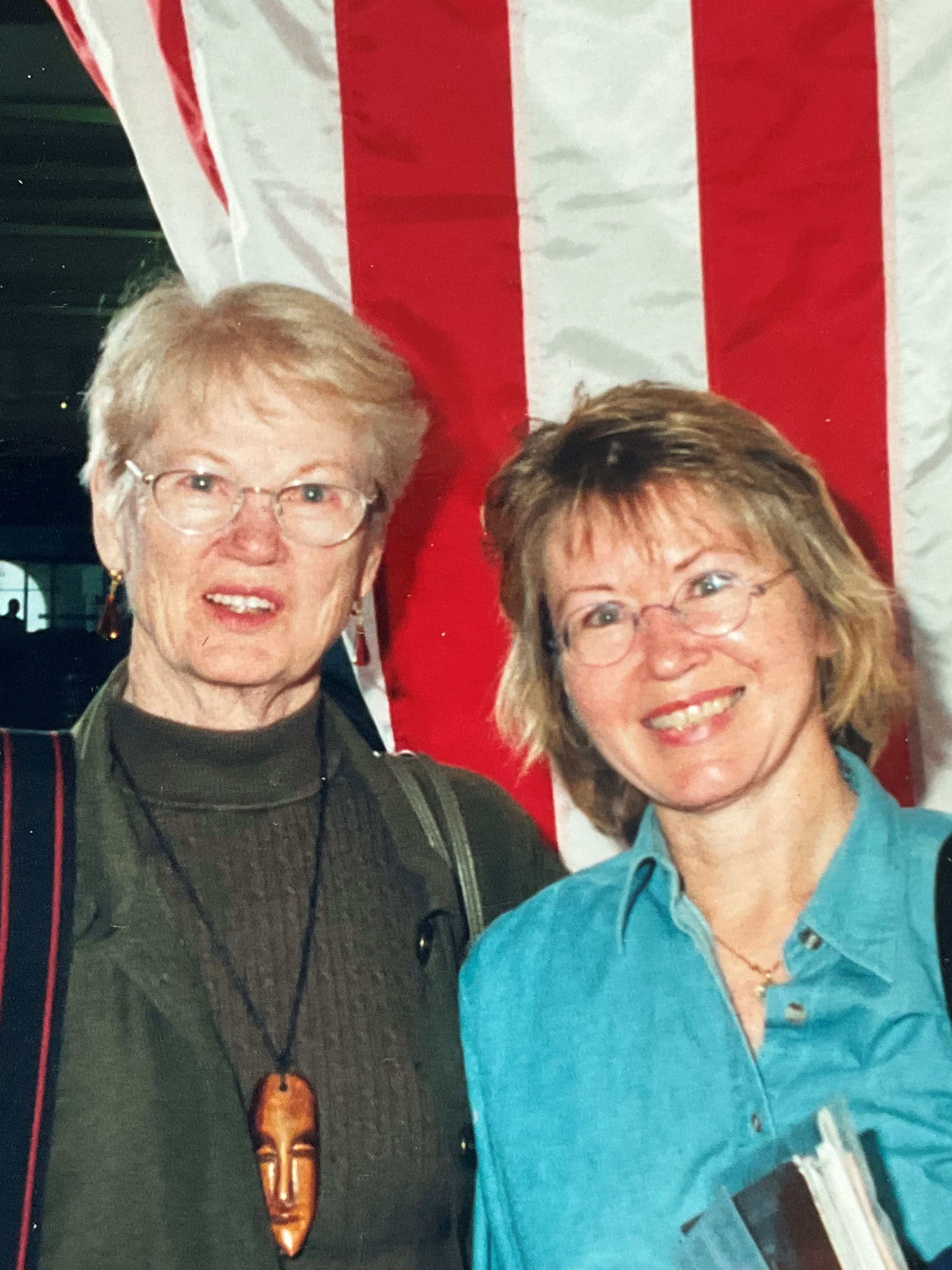
Scrolling through family photos for a suitable picture of myself, I pause at a photo of Mother with her short, blonde-tipped auburn hair, generous smile and sparkling Paul Newman blue eyes. She would have been in her sixties then, around my age now. This picture was taken decades before Alzheimer’s would cloud her shining eyes and steal her gentle soul. I had to paint her.
Our instructor was teaching us how to create pastel portraits in a loose and expressive style. My Mother seldom used pastels. Conté pencils and watercolors, sometimes, but her preferred medium was oil. She was trained in Classic Realism. Think Renaissance. Impressionism. Great Masters such as Sargent, Degas, Renoir, and Manet. She earned her fine arts degree in her 50s, taught portrait classes, exhibited her paintings in groups or solo, and worked on commissioned portraits all while raising five children. Pre-Supermom she was. Dad was often travelling for business or training with the reserve army. Postwar Parents.
Sometimes the models sat in our studio at home, and sometimes Mother worked from a 4×6 Kodak colour photograph with the aid of a magnifying glass. Life before Computers.
With her palette smeared with fresh dabs of paint, Mother’s brush was her magic wand, breathing life into the face emerging from the canvas. Her gift, I always said, was her ability to capture not only a true likeness but some essence of her subject’s personality as well.
Our online instructor taught that emotional expression is rendered through three facial features: eyes, eyebrows, and mouth. You can’t combine a frowning brow with smiling lips any more than you can smile when you are angry. Getting the proportions of these three features correct is essential to achieving a great likeness. When I lived at home, Mother would sometimes ask me to read a model’s expression in her current portrait. Without realizing it, I was absorbing her critical painterly eye. I was becoming her third eye.
This morning, I set up my tabletop easel and tape a beige sanded pastel paper to a foam board for support. I open my laptop to the picture of Mother, which is saved to my desktop. I crop the front view to head and shoulders size and enlarge it with two fingers. On a paper towel, I organize my soft and hard pastels by colours and values of cool, neutral and warm to create her fair skin tone and hair colour. I keep a tissue handy for blending.
Using my wooden skewer stick, I measure Mother’s cheek to cheek width and hairline to chin height proportions and apply corresponding marks on my paper. Using a vine charcoal, I lightly mass in the larger shapes of her head and hair and neck.
Next, I subdivide the head in thirds marking hairline to eyebrows, eyebrow to nose tip, nose tip to chin. Honestly, who knew there were so many general rules for drawing an adult face? I position the eyes (halfway down the head) and lower lip (halfway between the nose tip and chin). Did you know the width of one eye is equal to the width between the eyes?
Suddenly I remember the first time I drew Mother’s face. I was asleep. It was weeks after her death. I was tracing her features with my finger so I wouldn’t forget her face. In my mind’s eye, I drew her mouth, with the little scar above the upper lip, and the round bulbous nose, (a shape I inherited), and then her almond shaped crystal blue eyes. My eyes are also almond shaped, but jade green.
Instantly, my sketch transformed into a photographic image of Mother’s face. A second later I sensed a heaviness in the air, and a dense presence right behind me as I lay on the bed. My heart raced. Hair prickled on the back of my neck and the hairs on my forearms tingled. Was I still sleeping? I held my breath and body still, although I couldn’t have turned over if I tried. My highest Self, my Soul, knew immediately who it was. “I love, love, love you,” the thought flew wordlessly to her. “I love you too,” Mother whispered back. Then she was gone.
If I drew her to me then, I wondered, while her spirit still hovered, could I do it now? Or has she moved on to a distant non-physical reality?
I always said I lost my Mother years before she died. How could the person who knew you so well not know you anymore? The disease took something much more than our Mother and Daughter bond, it stole a part of my Self, the overlapping part that was Us in our Venn diagram.
How amazing it would be to talk with her again. She was a creative and adventurous soul with an inquisitive mind and a kind, open heart. We shared several interests: art and design, reading, travel and spirituality. She had her guitar; I had my writing.
If we could meet again, senior to senior this time, we could continue attending local art exhibitions and visiting museums and galleries. We could discuss painting techniques, styles, favourite portrait artists and Impressionist artists from the 19th and 20th Centuries. Does she know my artistic brother and I divided her coffee table art books of the Great Masters? I also kept several wellworn hardcover textbooks on drawing and anatomy, portraiture and painting from her university art classes in the seventies. Not sure why. The chance of me ever referring to them was as likely as living through a global pandemic.
I always said, if we could talk again, I’d take more of an interest in our family’s ancestry, especially since researching and writing about Dad’s grandparents. And I’d not forget to get her recipe for tonic teas she made to keep up her energy after she stopped drinking caffeinated coffee.
I remember her coffee days with women friends and afternoon tea with sisters-in-law. Their conversations always revolved around children and health. I’d hear her telling Dad later that so and so came down with such and such. Didn’t seem to matter to them whether they knew the person or not. Now I get it. Emails between my girlfriends always begin with weather and end with health news — our own updates as well as those of friends we’d never meet. (When did the pursuit of health trump wealth?)
If I could talk to Mother again, I’d be sure to take notes about our family’s medical history, like when she was diagnosed with osteoporosis, and when they knew about Dad’s heart. Or her memory. I remember how upset she was with herself when she started to forget. Like the time she walked across the road to the store for milk — who needs a list for one thing? — and came back empty handed. Almost as distressing to her was her inability to remember her dreams. Dreaming kept her connected to her intuitive subconscious, or higher Self. I get it. I keep a dream journal.
I smile at the memory of us chatting in another dream. We’re sitting on a single bed, like two teenage girls, having a lively conversation about who knows what. Her back is against the headboard and her knees are folded up. I remember her confiding that her girlfriends all had a crush on the same famous American football quarterback. Who I asked? When she named a handsome player from the 60s, something shifted in me and I realized I was talking to Mother. I reached over to get her attention and my hand unexpectedly collided with her solid knee. She stopped mid-sentence.
“We’re really talking,” I blurted in awe. “We haven’t talked to each other in so long,” I added wistfully.
“I know,” she answered, and I sensed her sadness.
That was my first lucid dream, which is when you become aware of yourself in the dream and can sometimes alter the dream narrative. I read later that lucid dreams satisfy the mind’s desire for clarity. The information may be symbolic or literal.
My one other lucid dream was definitely clarifying. I was at a country wedding and dancing on the lawn with another girl my age. We were trying to polka, twirling and laughing, all legs and arms. When I became aware of myself in this dream, I stopped dancing. I was confused. This girl was my Mother, I was sure of it. I pulled her closer and stammered: “But I thought you were dead.”
I could still hear the sound of Mother’s voice in my head days later: “No I’m not,” she smiled happily. “I’m still alive.” We never talked in my dreams again.
I read the easiest way for spirits to reach us is through our dreams when our rational mind is asleep, and our intuitive subconscious mind is receptive. I once dreamt I was at a family reunion, walking amongst family members and chatting away with relatives I hadn’t seen in a while. There was Grandpa in his white collared shirt and suspenders. It was all so normal until I looked around and realized I was the only person with a living body. Did they know I was a Heavenly Gate crasher? Did it matter?
Over the years I would catch sight of Mother in my dreams at other gatherings. She would be standing off to one side, in the shadows, or partly hidden behind a group of living relatives. “There’s Mom,” I’d point out happily to Dad, or one of my sisters, but they could never see her.
I begin blending the neutral tones of her pale skin with my index finger, pushing the middle values out to darker areas of her face. I pause on the spot between her eyebrows, and the paper warms beneath my fingertip, like the heat you feel after rubbing your palms together. I’m on the 6th chakra, one of seven spiritual centres of energy in the body. This is also called the Third Eye, where our perception and intuition lie. Could I reawaken our spiritual connection by rubbing her forehead?
I draw in the curve of Mother’s eyebrows and the shape of her eyes and narrow eyelids. Making sure both eyes are level, I lightly draft the position of each iris, and darken a spot for the pupil within.
Then I cover Mother’s left eye with my open palm to confirm that her right eye is looking directly at me. When I cover her right eye, I see that her left eye is off centre, looking over my shoulder. I stop here, recording today’s progress on my iPhone camera.
As I place tracing paper over my drawing, it occurs to me that I could be painting my future self. Mother’s eyes, and nose, and mouth — the very three features that make a person recognizable or a portrait lifelike — are similar. What’s more, we both have light hair and fair smooth skin.
Our likeness never registered back in my Self-Absorbed Twenties when we were in Florida and these deeply tanned and leathery Miami women mistook us for sisters. Life before SPF. (But I never used baby oil again.) I assumed the compliments were related to our pale and wrinkle-free Northern skin. But it was our shared facial features they had observed.
Mother was born in Norway and came to Canada as a child. In my 50s, I took a DNA ancestry test which estimated I was 85 per cent Norwegian and 15 per cent Irish and/or Scottish (my paternal side). I also found out only two per cent of the world has green eyes, and 85 per cent are from Northern Europe.
Drifting off to sleep that night, I imagine Mother asking why it took me so long to get to the easel. Was she aware of some inherent artistic abilities, the reason she enrolled me in that community school art class at five? My A+ in Art at school? Seems once I learned my alphabet I found another creative use for pencil and paper. Stories. I would set up a child’s table and stool in my bedroom closet, run the cord of a night lamp under the closed door, and write in my oversized scrapbook. Mostly ghost stories. Encouraged by my Grade 12 English teacher and my English prof, I decided to pursue a career in publishing.
It never occurred to me growing up to ask Mother to teach me to paint people, or animals, or landscapes for that matter. Did she hope I would? Or would she have been hesitant to steer me towards her passion, her chosen profession. How might early encouragement have altered my career, my life?
A handful of times over my writing life, I would enter that zone of complete focus. This state of “flow” was discovered by a Hungarian psychologist in the 70s. His concept was when the mind is still, it could be more receptive to receiving information through energy waves.
Mother would surely have entered that meditative state while painting. She used to say when a model sat for hours at a time, she would sometimes receive impressions from them, sense their mood or feelings beneath their stillness. Perhaps it was that subliminal connection that allowed her to capture a sense of the person’s spirit, not just their likeness. I remember she once told me her receiving senses were stronger in her left ear.
The next morning, in that transitional state of wakefulness before the mind takes over, it comes to me that it was Mother who inspired me to start drawing portraits a few years back. It was during the Covid-19 global pandemic. I thought it was the boredom of lockdown the summer of 2020 that sent me looking through family pictures for people to draw. Over the next two years, I probably drew over a dozen family members, first in pencil, then charcoal and finally pastels. I was pleased with my efforts in achieving a likeness and the progress I was making.
But that was a pandemic pastime. Wasn’t it? What prompted — who prompted — me to fork over hundreds of dollars for this online portrait course in soft pastel when it appeared in my Facebook feed last year. What compels you to act first and decide later? Is it my creative superconscious nudging me to commit? Or that quiet voice of intuition that patiently reminds you to do something until you do it? Or was it Mother?
I sit down with my coffee in front of the easel, and immediately see that my things have been rearranged. A clean tissue covers my dusty array of chalky pastels, and several hard pastels and colored pencils are lined up for today’s refining stage. My husband wouldn’t touch my art things. How?
The top corner of my tracing paper flutters in answer. I lift it away from my drawing and my heart lurches. Both of Mother’s pupils are staring straight into my eyes. I grab my iPhone to confirm what I am seeing and look back at the colourless eyes focused on me.
“Mother?” I whisper.
I tap awake the color image of her on my computer. Her blue eyes sparkle with life, her glowing cheeks lifted in a happy smile. “Draw what you see,” her advice to me during Covid echoes again in my head.
Using the colored pencils that were laid out before me, I bring her eyes to life. I darken the outline of the iris and fill it with a combination of blue violet and apply a hint of yellow rays to create eyes that seem to shine from within. I add a touch of pinkish grey to tone down the white corners of the eyeballs. I blacken her pupils and add to each a white dot of reflective light.
Our instructor often reminded us to step back and squint. Squinting blurs the details so you can better see the dark and light values. I step away. Squint, squint. And that’s when it happens. Mother blinks. It’s so quick I think it must be me squint squinting. I blink slowly a couple of times, then rapidly, trying to catch her blink again, but her sharp gaze remains steady on me. Are my eyes playing tricks on me? I step back to the side this time, and her blue eyes follow me. If eyes really are the window to your soul, could she see me through her crystal blue eyes?
I begin working on Mother’s hair, defining its shape and direction with loose bold strokes, noting where the light source creates highlights and shadow, capturing hair depth and texture. Mother always used a curling iron to give her fine hair more height and body. Her auburn color had faded over time to rosy blonde before turning silver white. I notice my own hair has become finer since I stopped highlighting it in the second year of the pandemic. It’s turned from ash blonde to ashy beige with platinum blonde streaks framing my face.
One of the ways to create a loose and expressive portrait is by using soft or hard edges. Our instructor called them lost and found edges, and they help direct the viewer’s eye to the painting’s focal point. I apply a few hard, heavier strokes along the hairline where it meets the skin and smudge it near the temples. “What you leave out is just as important as what you leave in,” Mother reminds me. I finish with a few more lost edges and small descriptive marks to give her hair character, blurring a few waves and stray whisps with my tissue.
It’s like my arm has become my magic wand moving quickly, yet effortlessly, around the portrait, confidently darkening shadows here and pulling out highlights there, darting deftly from hair to neck and back to the face. I’m in the state of flow, where my skills are equal to the challenge. Do what you love, and flow will find you, I hear myself reciting from some book I read.
One time in grade school I came home and told my Mother the teacher asked why I was sad.
“Were you?”
‘“No, this is my face,” I pointed to it for clarity as I made my face expressionless.
Mother just nodded and said I should smile more — especially for pictures — because my neutral look could make me look unhappy. It’s only now I realize that we both have the same downturned mouth.
Knowing my beginner tendency to make the eyes too big and the mouth too small, I remeasure Mother’s mouth, dropping my wooden skewer from the inner corner of her eyes to the outer edges of her mouth. Oddly enough, her mouth is wider than my original corner lip marks. Wider, in fact, than the reference photo. The birdsfeet around her smiling eyes have stretched. Her parted lips are curved back and contracted facial muscles deepen her laugh lines and raise her cheeks. She is giving me a big smile for my portrait, as she taught me to do. “Hold that smile,” I say to her, as if she were sitting across from me.
When I was little, I used to watch her apply her lipstick, pursing her lips together as she snapped the swivel tube back in the little mirrored case. Her crimson lips always brightened her entire face. Mother never left the house without wearing lipstick — even to the grocery store. Red Lipstick Feminism celebrates a century.
Although we only wear one shade of lipstick at a time, an artist needs at least three shades of color to create lifelike lips. Mother’s pale skin has a cool blue undertone requiring a blue-based red color. I choose the darker brick shade of the three red pencils Mother has laid out to draw the shape of the inner lip lines from the middle out to the darker corners. I use a middle tone to shade in the upper lip, and for the bottom lip, I use the lightest of the three red hues. Because the bottom lip catches more light, I finish with a smudge of white in the centre. The result is so lifelike I wonder if I can make my thinning lips appear fuller by applying a lighter shade of lipstick to my bottom lip. Life imitating Art.
I have learned that each artist sees with unique eyes. It’s why the drawings of a sitting model in an art class are all so different; the students are drawing what they see, regardless of where they sit around the model. When we look at an original piece of art, we are seeing an artist’s unique expression, their distinctive style and technique. Through their art, the artist lives on, and I have no doubt Mother lives on in the hearts of those who have her portraits hanging on their walls.
Mother’s DNA is in my face, my nose and toes, my outlook and my creativity. I lived inside her. She lives inside me. She gave me her passion, her gift, to discover when I was ready. Sadly, she did not live long enough.
I don’t have children to inspire any artistic desires, but I am grateful to have several siblings, whose children now have children, and friends who have grandchildren. I have many models to continue to practice and develop my own style and technique.
I now know Mother has been guiding me to take this next step, like she did that first day of school, my hand in hers, leading me up the many steps to those double oak doors. I had no idea what lay beyond. I simply trusted my Mother to show me where I needed to be.
I take a black graphite pencil to sign and date my portrait. When I look up Mother’s eyes are glistening.
To our own memories of Mom on Mother’s Day, 2024. Love Dawna

 word traveller
What a great article . Sharene
LikeLike
What a wonderful article.
I had tears in my eyes when I finished.
Sharene
LikeLike
I am so glad you liked it. Thank you. Hope all is well with you both.
LikeLike