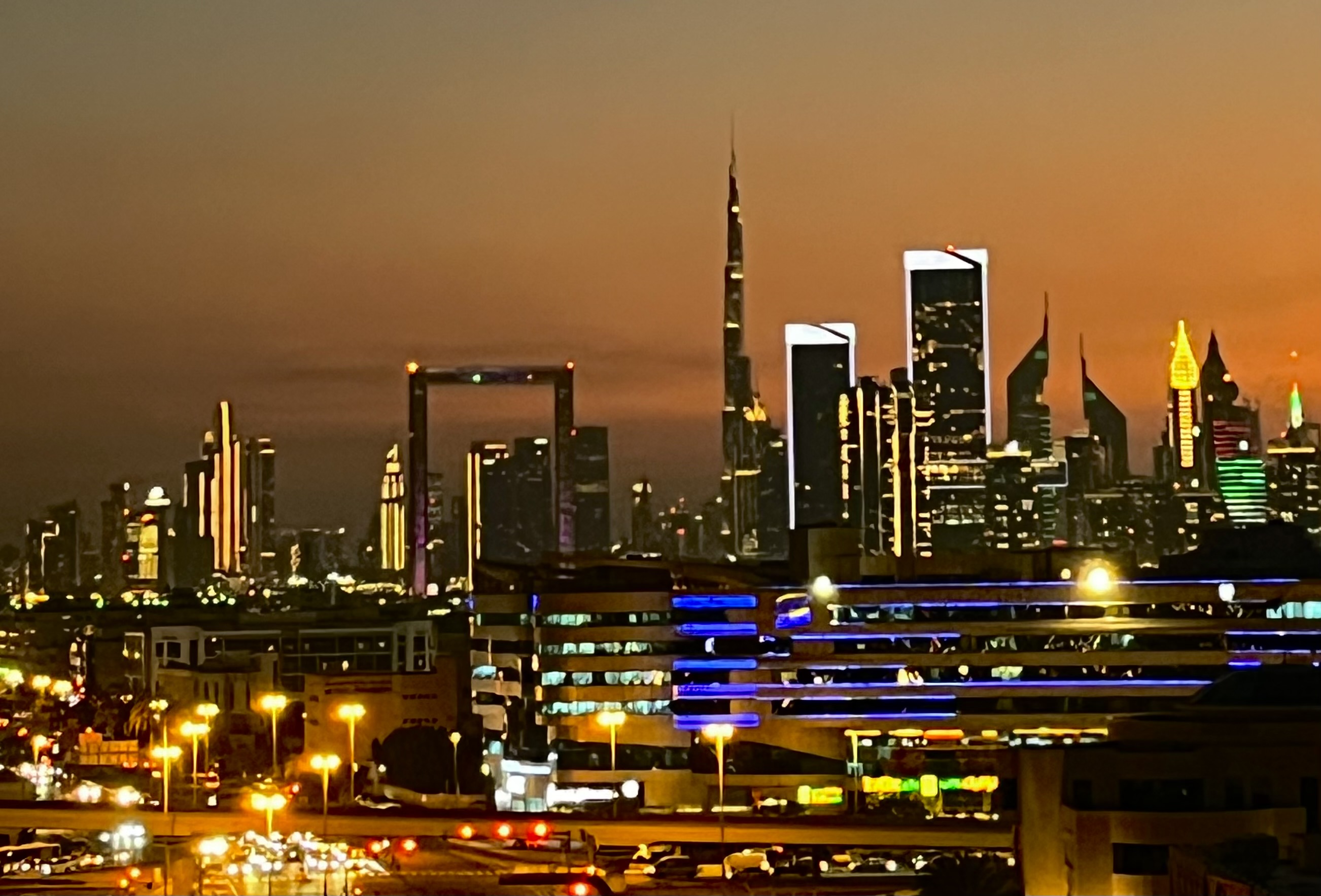
I was apprehensive flying to the Middle East, with Israel and Hamas at war for months, but only a terrorist act could cancel our December trip. We landed in the dark Arabian desert and nosed up to a bright and bustling airport. Soon I would discover we had flown into a green geopolitical oasis, where wishes for peace, hope and prosperity were not sentiments scrawled on Christmas cards. This was reality in the Emirates.
From Rages to Riches
It wasn’t always so. A generation ago, the people of this sea and sand country were poor fishermen along the coastal Gulf waters or Bedouin tribespeople in the interior desert. Even after the discovery of onshore oil in Abu Dhabi in 1958, and commercial production in 1962, life did not improve for the 135,000 tribespeople living across the local emirates. Until one sheikh, a member of al Nahyan, the oldest ruling Abu Dhabi clan, peacefully displaced his elder brother to bring the royal family’s wealth to the people.
It was a decade after oil and gas money began flowing that Sheikh Zayed bin Sultan al Nahyan formed a federation on Dec. 2, 1971, with the other autonomous emirates to create the United Arab Emirates (UAE). We arrived on the last day of their national holiday celebrating 52 years of unification.
The UAE is a young country with a long past. Its Arabian history dates to at least the Bronze Age, and remains of forgotten cities might still be found in the Empty Quarter, that vast Saudi desert that crosses into Abu Dhabi. The country was, and still is, an important trading route linking Africa, Asia and Europe.
This is the mystical Middle East, where folktales about fabled characters like Sinbad, Aladdin, and Ali Baba filled young Western minds with images of genies in bottles, flying carpets, lost cities, and nomadic tribes on camel caravans plodding over wind-crested sand dunes in scorching heat to find water and shade.
Today’s older generation must be forgiven for thinking they, too, are living a fabled life given their country’s astonishing transformation over a short 52 years.
The UAE’s population in 1971 of 345,000 is now 10 million. Maine, USA, is a comparable size with 1/10 of the population. Pure Emiratis (they all know from which tribe they descended) receive free health care, free education, and free housing. The government’s welfare system assists young Emirati couples with the bride’s dowry (it’s hers alone to spend) and provides a monthly allowance for each child. No one, including foreign workers, pays income tax. Women are treated as equals in pay and representation. Dubai’s bus service only started in 2008, followed by its Metro in 2009.
Big Brother Aids Little Sister
Dubai is the most well-known of the seven Emirates and, while smaller than Canada’s Prince Edward Island geographically, it employs 85 percent of UAE’s foreign workers, meaning only 15 percent of its residents are Emiratis. Surprising to some, Dubai is not the capital of the United Arab Emirates.
Abu Dhabi is the seat of the federal government, its cultural centre, and oil and gas capital. It’s the largest Emirate with 86 percent of the land mass and 95 percent of the oil reserves and revenues. In 2022, it was the 7th largest oil producer in the world after the United States, Saudi, Russia, Canada, Iraq and China. Abu Dhabi is the oldest of the seven Emirates; its royal family Al Nahyan has been ruling for nearly 300 years and it owns pretty much everything we see.
We walk through Dubai’s humble beginnings 200 years ago. At the historic neighbourhood of Bur Dhabi, we learn that pearling, or pearl diving, was this fishing village’s main source of income. The Great War, the Great Depression and Japan’s production of cheaper cultured pearls was devastating to this community. Big brother Abu Dhabi helped support the little emirate until Dubai could expand its duty free trading port to attract more seafaring merchants. Capitalizing on its location on the Arabian Peninsula, Dubai has grown to a global business and commercial hub in the Middle East.
A Camera Cannot Capture What The Eye Can See
Look around: Dubai is a calm yet vibrant city of 3.6 million. It is impossibly Tide-clean, incredibly safe and remarkably quiet. We don’t hear sirens or see homeless. There are only two seasons. Hot and hotter. The December air is warm and moist with temperatures ranging between 20C-30C.
Look out: West across Dubai Creek to the historic Deira to the souqs of dazzling gold jewelry and perfumed spices. This sea inlet was dredged, deepened, and widened to accept bigger cargo boats. To the city’s modern East wealthy communities such as the Dubai Marina rise on man-made islands. The iconic Palm Jumeirah is an artificial island shaped like a palm tree with luxury villas and resorts. Further out over the hazy horizon is more artificial island construction.
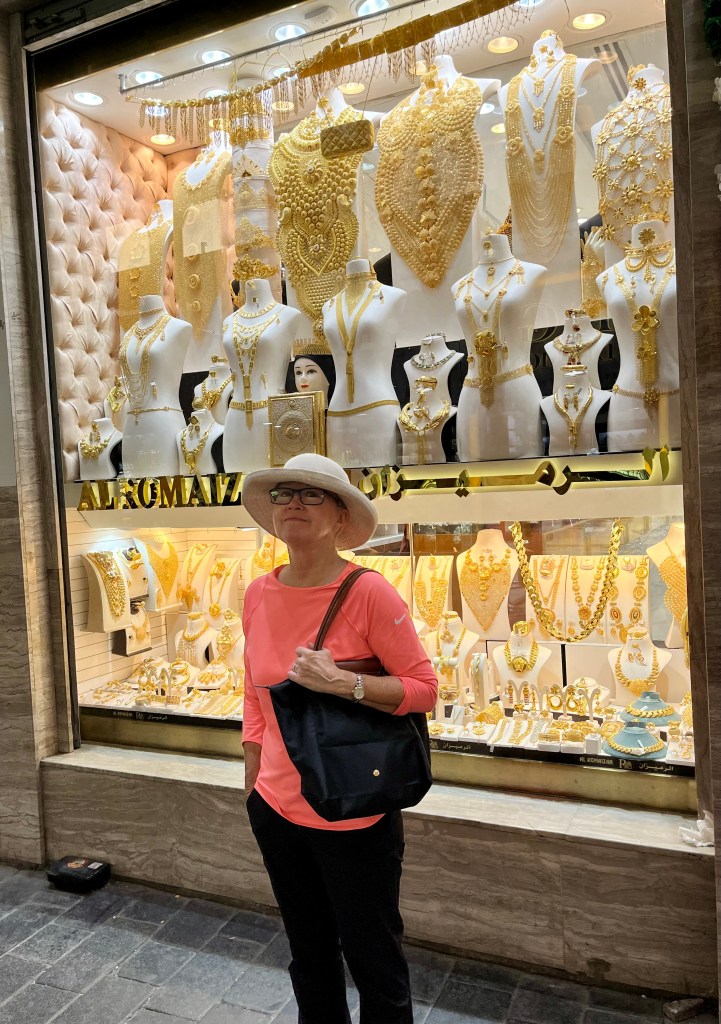
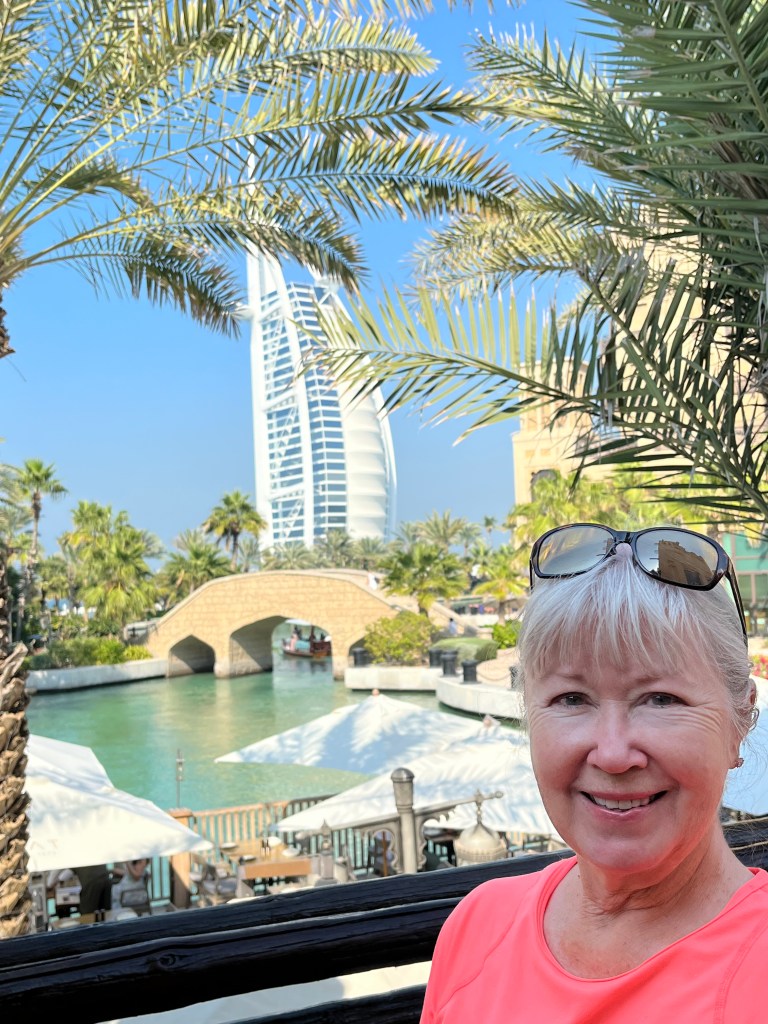
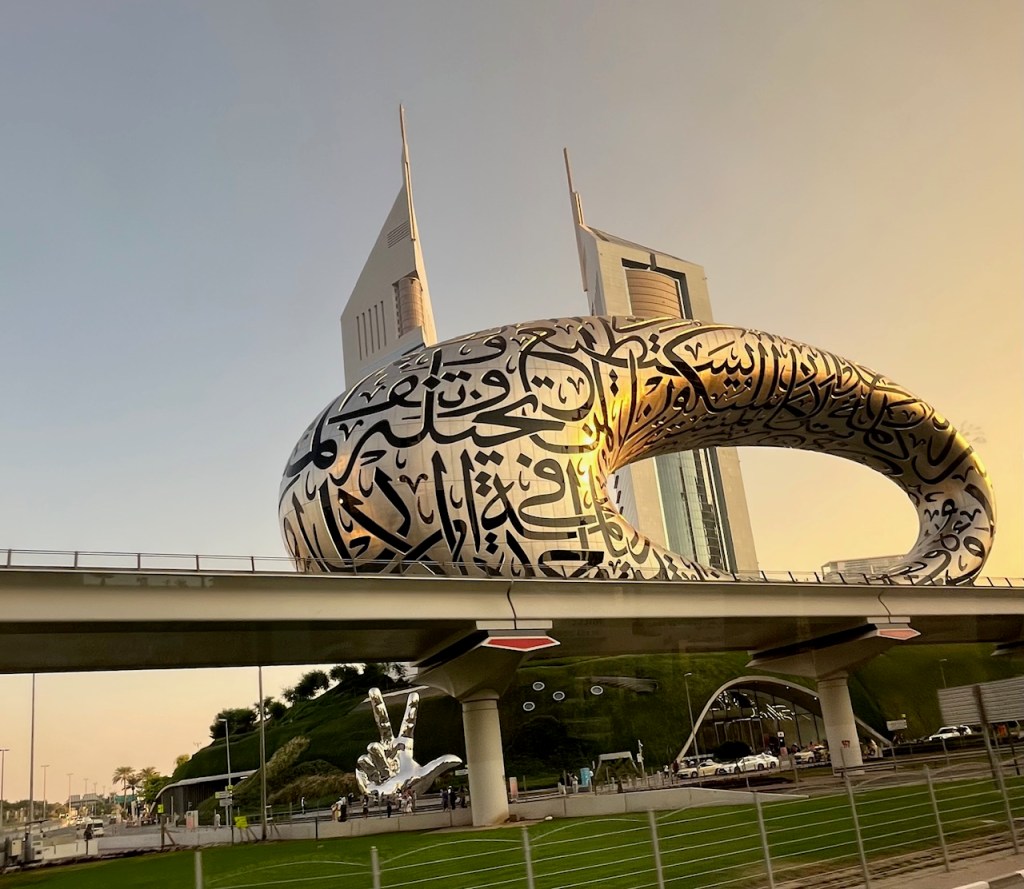
The Burj Al Arab, once the tallest hotel in the world, is where we celebrated my birthday. We are only permitted onto the island of this sail-shaped hotel with a reservation. Heading back to our hotel we see this huge silvery oblong orb hovering above the freeway. That’s the new seven-story Museum of the Future, where you can time travel to 2071.
Look up: Cloud-piercing skyscrapers, rivalling Hong Kong’s skyline, rise from the gulf Shores and out of neck-craning car windows as we taxi downtown. Up on the 148th floor observation deck of Burg Khalifa (the tallest tower in the world at 168 floors) we look down upon masterpieces of architecture; not stretched rectangular structures of glass and steel, but buildings that magically bend up to 18 degrees, and curved glass windows on arched and bowed towers. I saw a glass office tower in the shape of a Ferris wheel. (Their real Ferris wheel is the tallest in the world.)
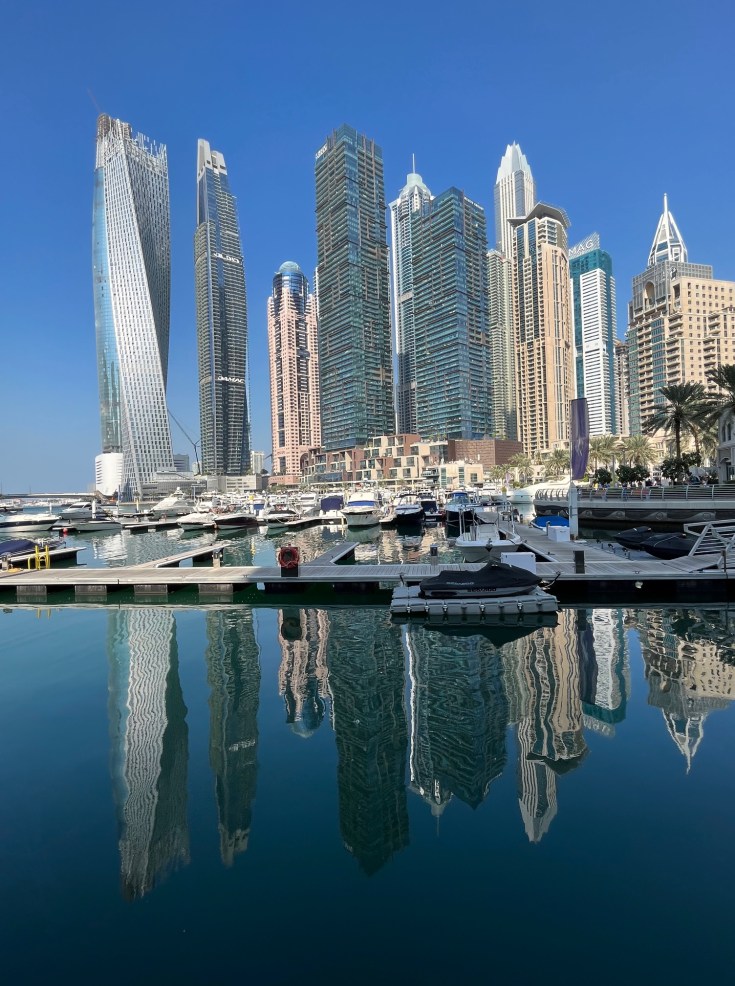
Dubai Marina 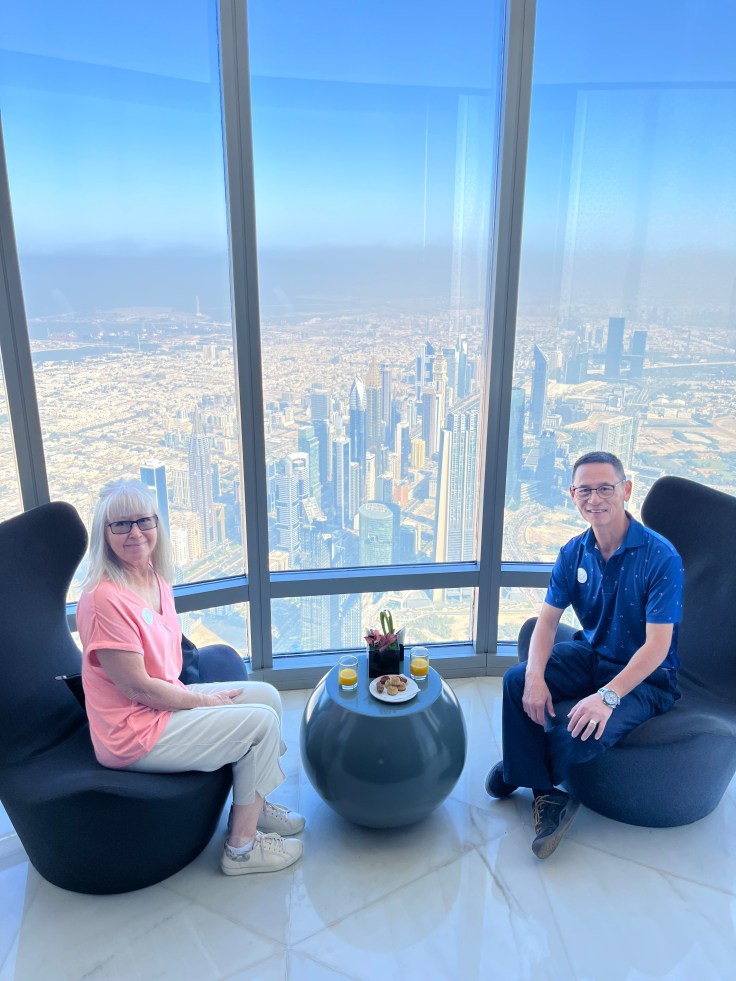
148th fl observation deck Durg Khalifa 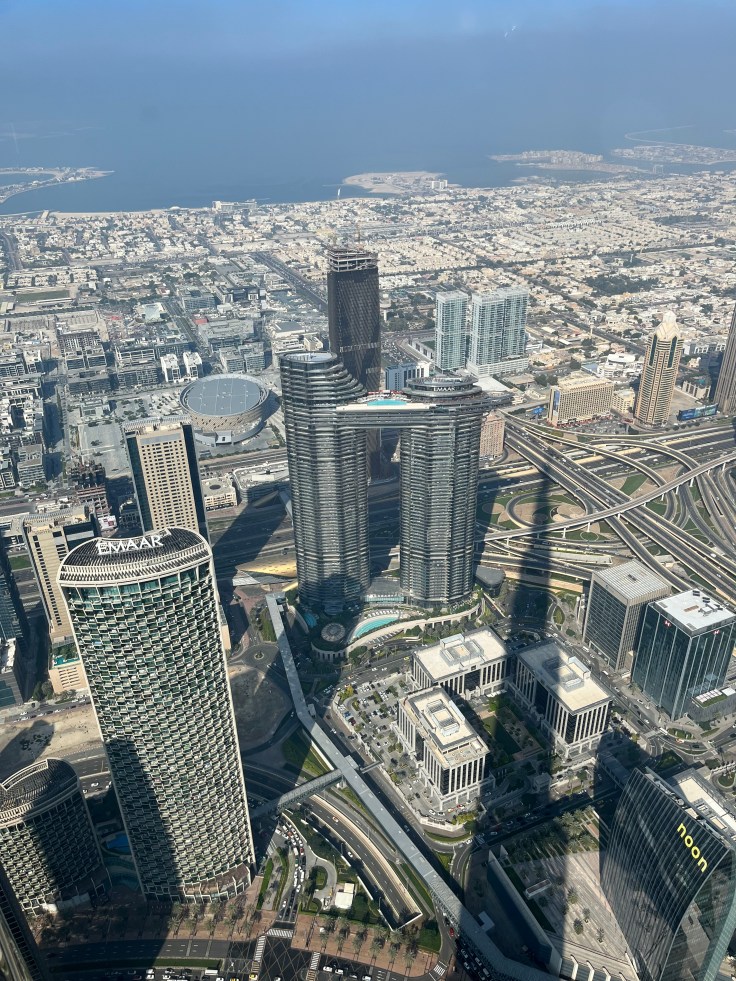
the pointed shadow is the tallest building in the world 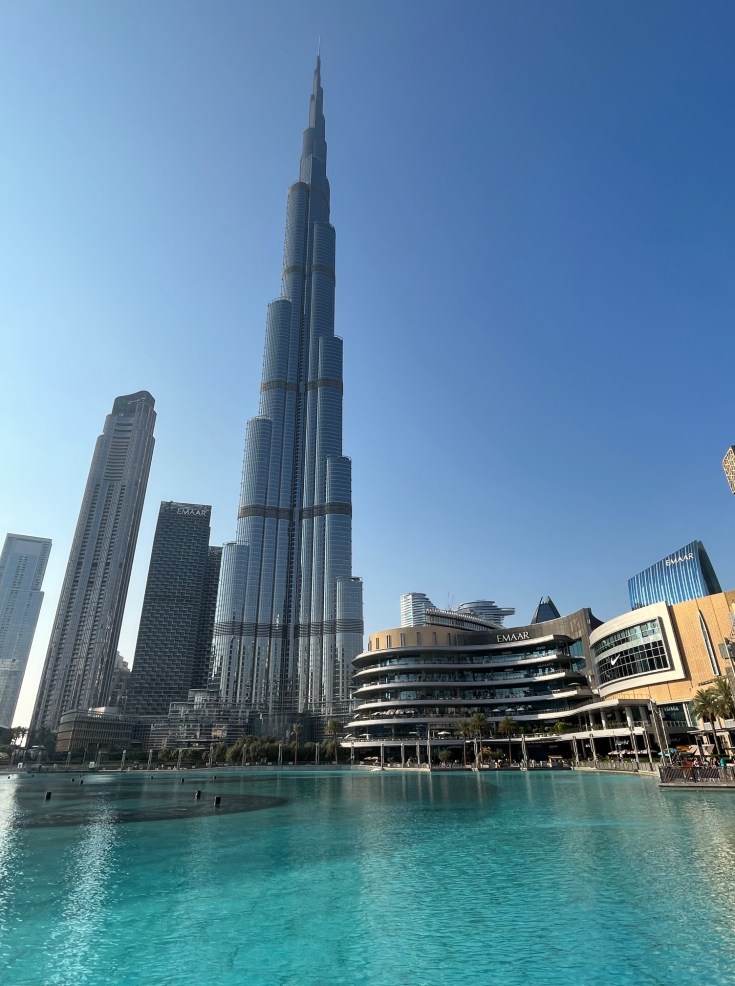
Burg Khalifa next to Dubai Mall
“Impossible is just an opinion here,” states our Sri Lankin guide Tony, who has been working in Dubai for 30 years. A foreigner, or expat, cannot live here without a work visa, he explains. If your employer lets you go, you have a month to find work or take their ticket home. Many of the non-Emirates are men from South Asia – Bangladesh, Pakistan, India, and the Philippines. Only three percent are Westerners.
Greener and Growing
Leaving Dubai, we cruise along the only freeway to Abu Dhabi, passing speed limit signs ranging from 80 to 180 km. But the only sign welcoming us to the capital city is the sudden appearance of trees. Millions of imported mangrove trees line hundreds of miles of boulevards, highways, streets, and the Corniche Road and promenade along the wide man-made beach. The mission to plant 44 million trees by 2030 is part of the royal family’s plan to achieve climate neutrality by 2050. I’m not even going to mention how they water these trees in the sandy desert.
Conservative Abu Dhabi is quickly catching up to its cosmopolitan little sister city and cranes compete for airspace amid newly erected structures. The government buildings, grand mosque and cultural museums beg for more original superlatives. They are more astonishing and lavish than I can describe.
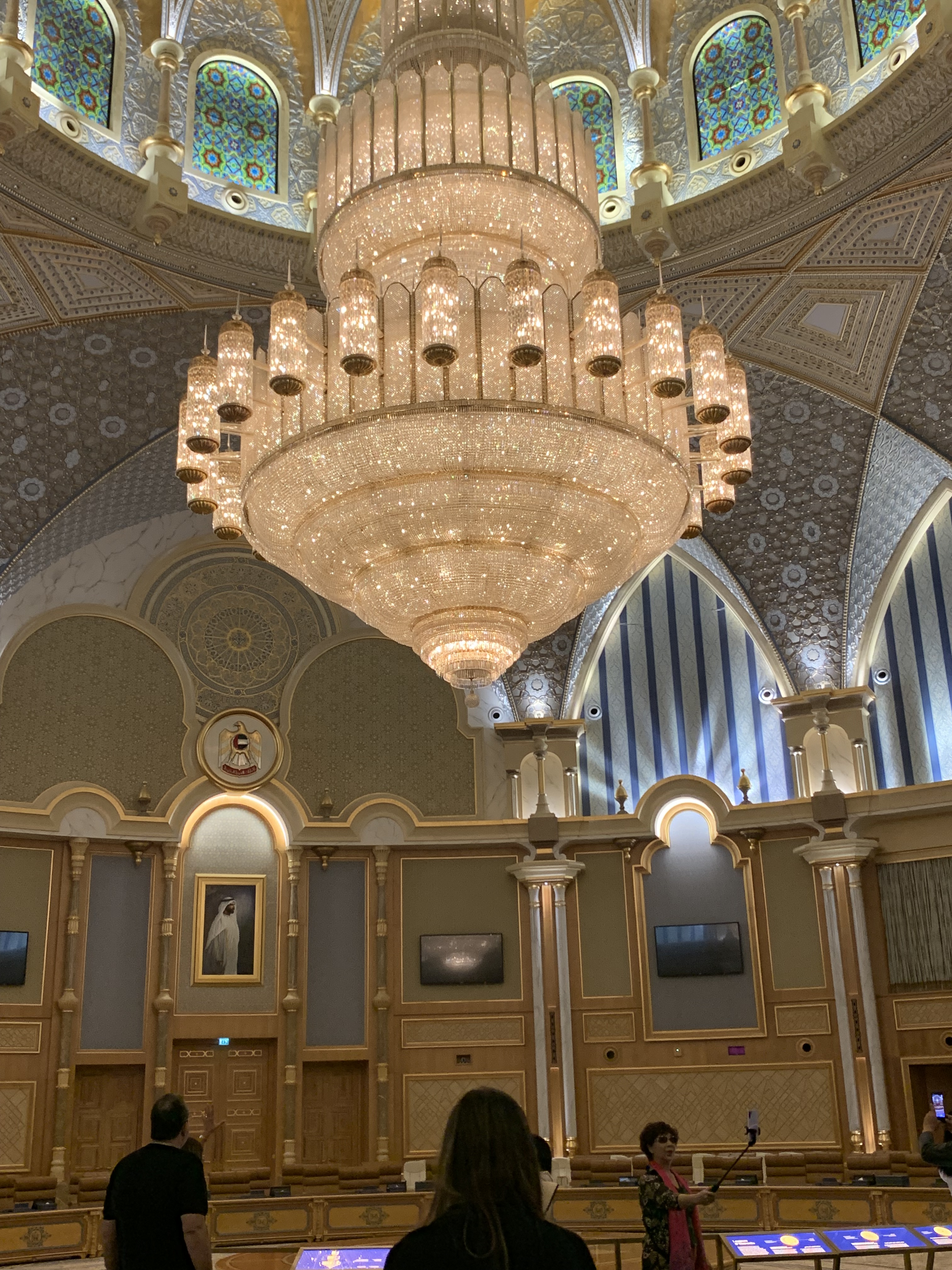
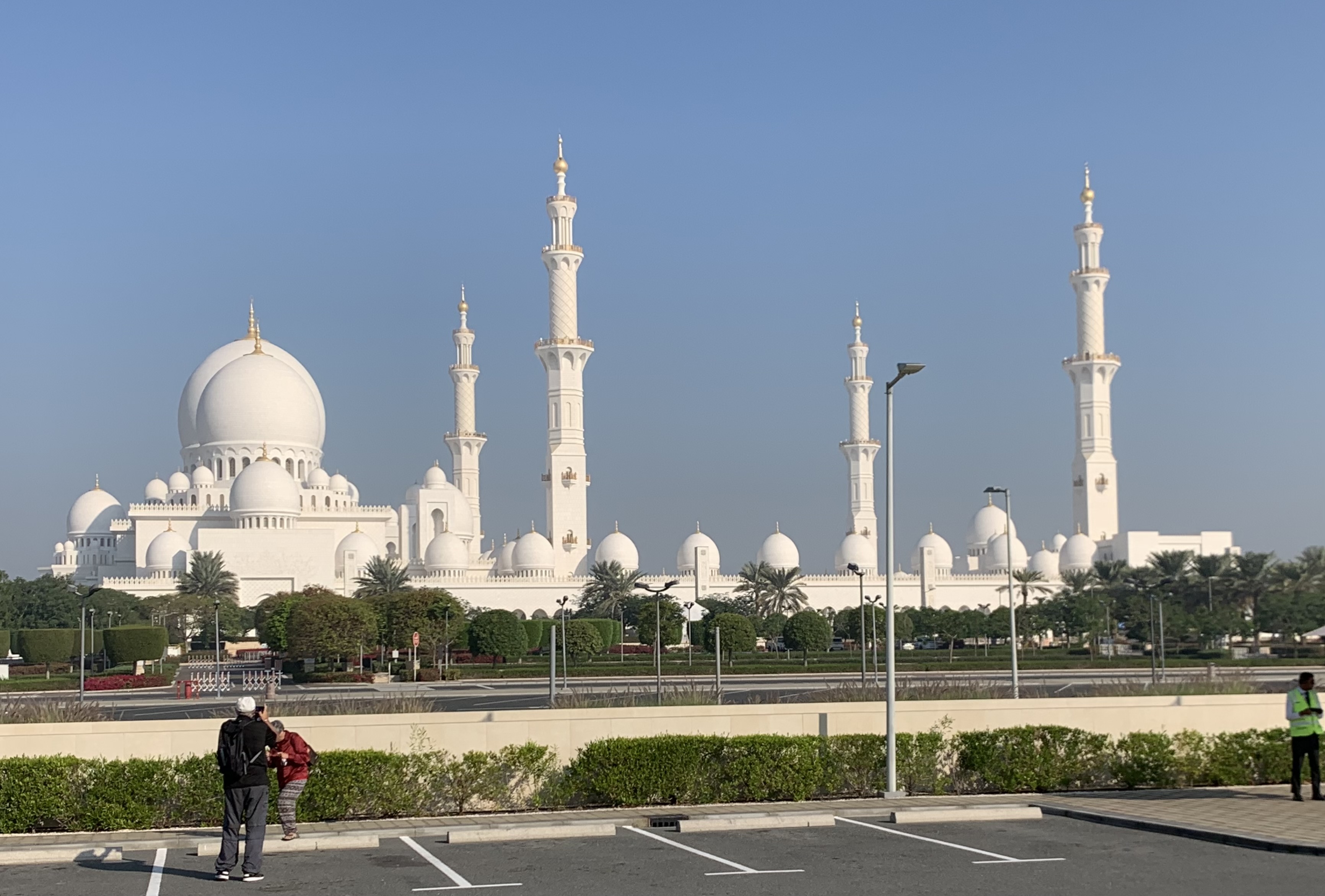
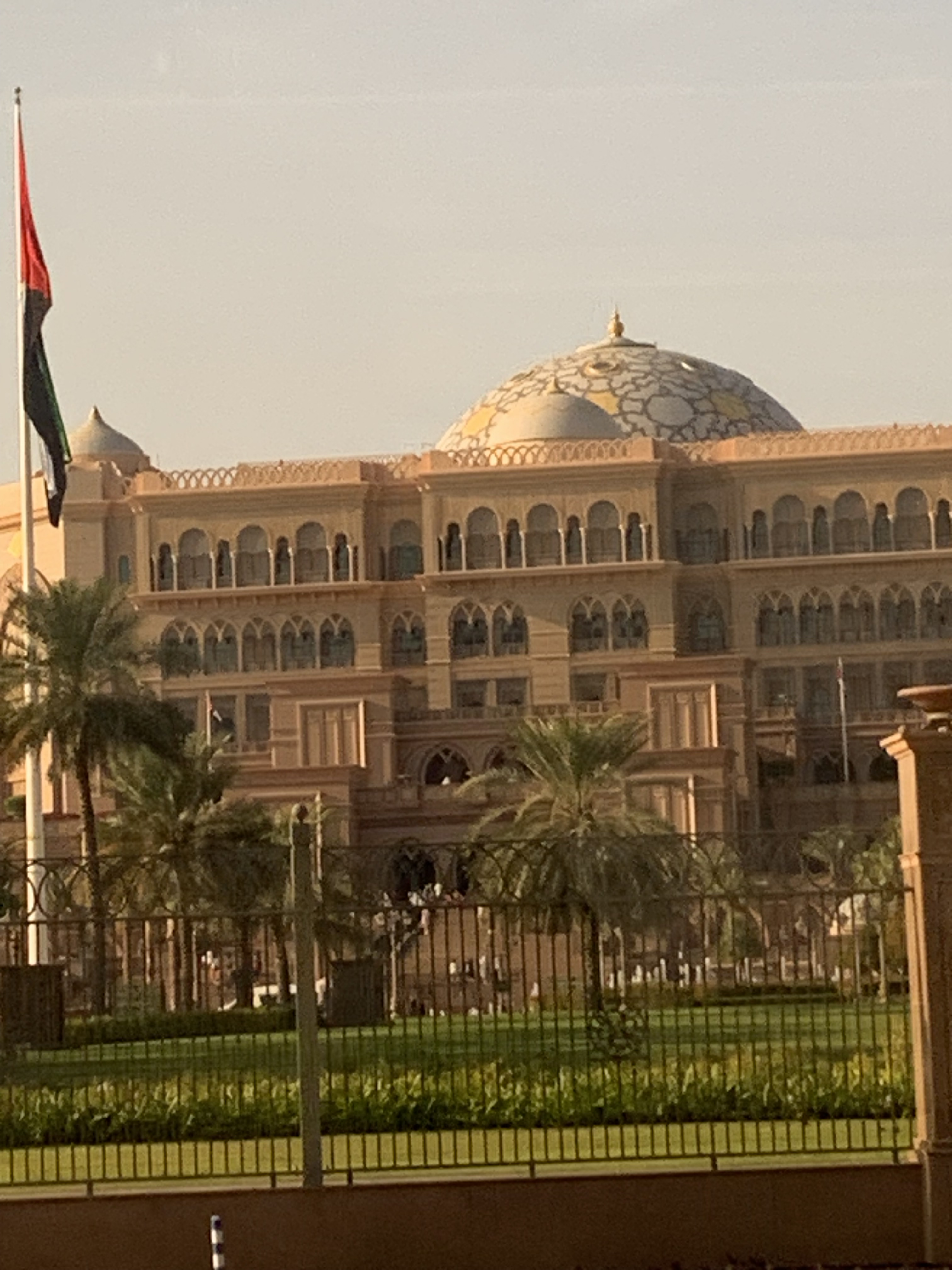
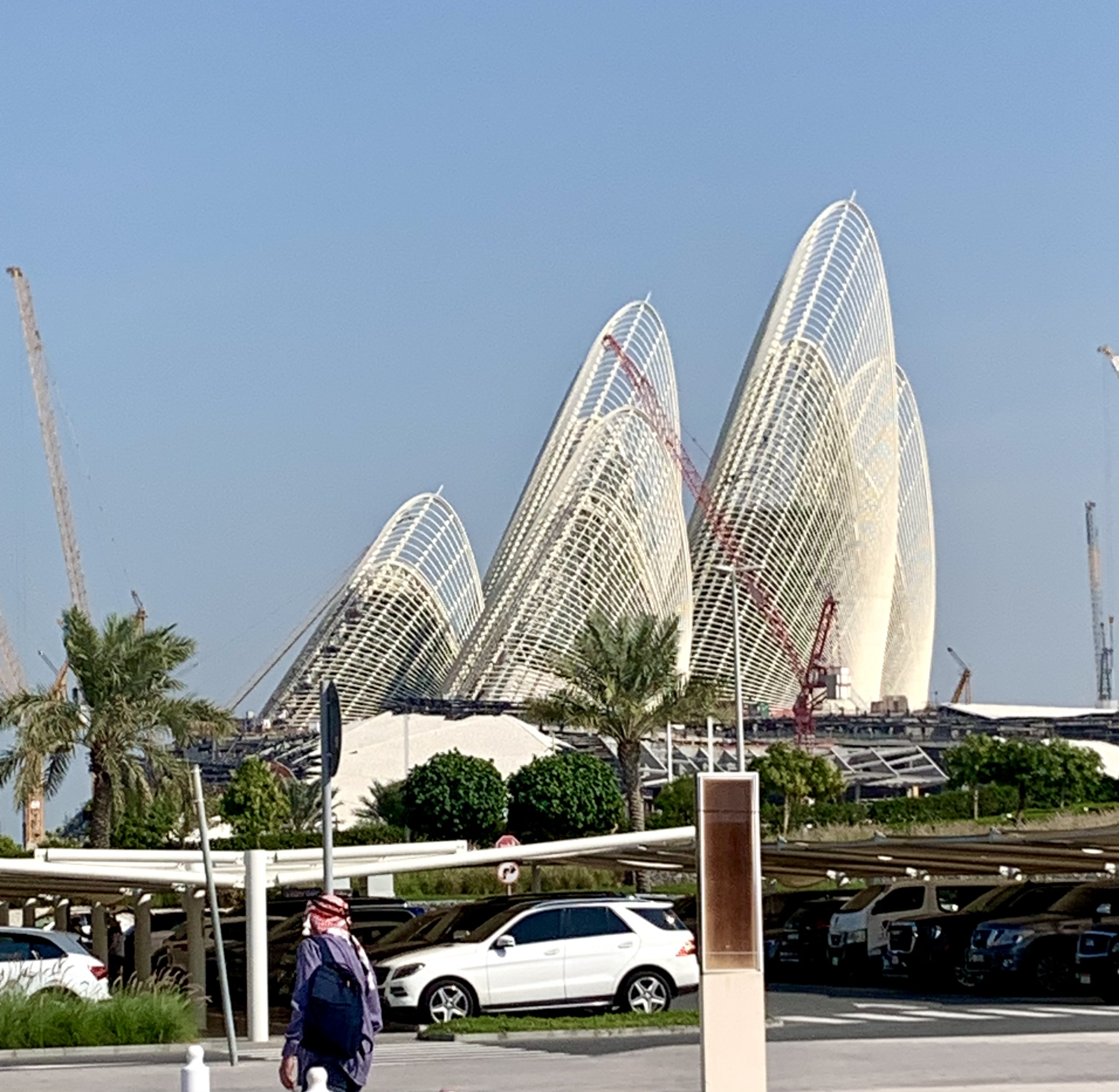
In the cultural district we visit the breathtaking Palace of the Nation, a working presidential palace, which would have hosted world leaders at OPEC 28 while we were here. Then we see the majestic Sheikh Zayed Grand Mosque, fourth largest in the world accommodating 42,000 worshippers. The world’s largest Swarovski crystal chandelier (20 ft wide x 30 ft high) drops from the ceiling. Rising from the roof of the unfinished Zayed National Museum are five enormous glass falcon feathers, a nod to the national bird. Our tours end at the domed Louvre Abu Dhabi museum, which showcases original holy books of the Koran, the Bible and the Torah encased behind glass.
A Model for Peace and Tolerance
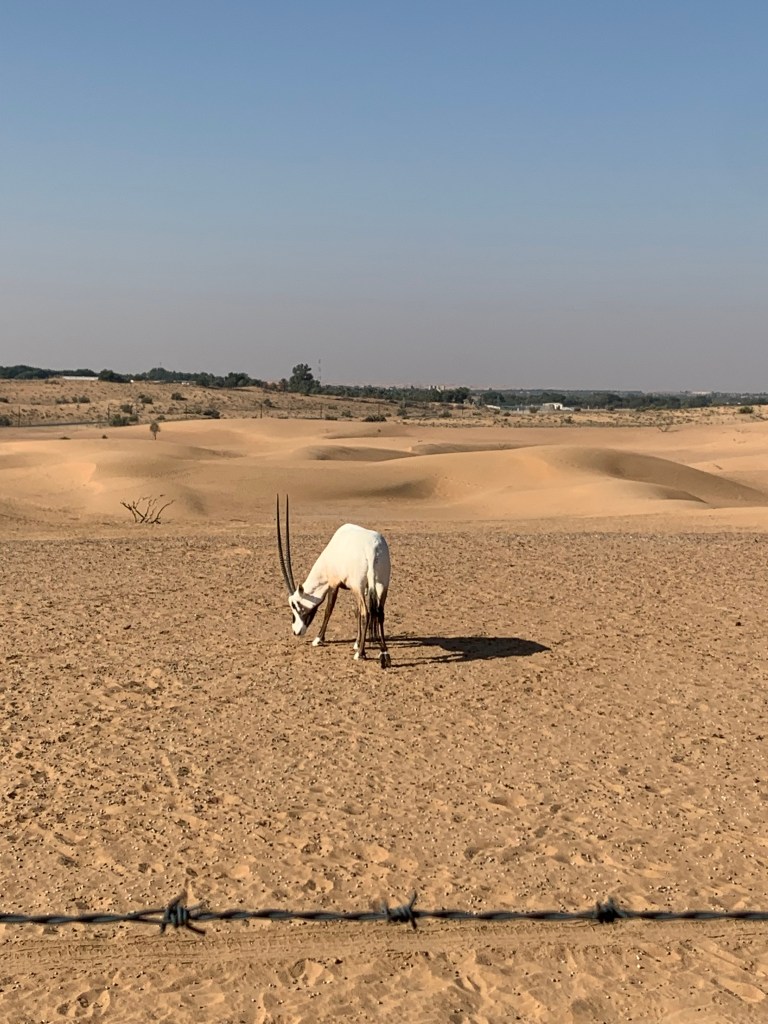
Abu Dhabi’s royal family, Al Nahyan, descendants of the Bani Yas tribe, has been ruling this Emirate for nearly 300 years. As we walked through the fortress of the first ruling family, we learn Abu Dhabi means ‘father of the gazelle,’ and the tale, retold by Tony, is that a gazelle led hunters from the Bani Yas tribe to fresh spring water on an island in the salty Gulf, and so the nomads settled.
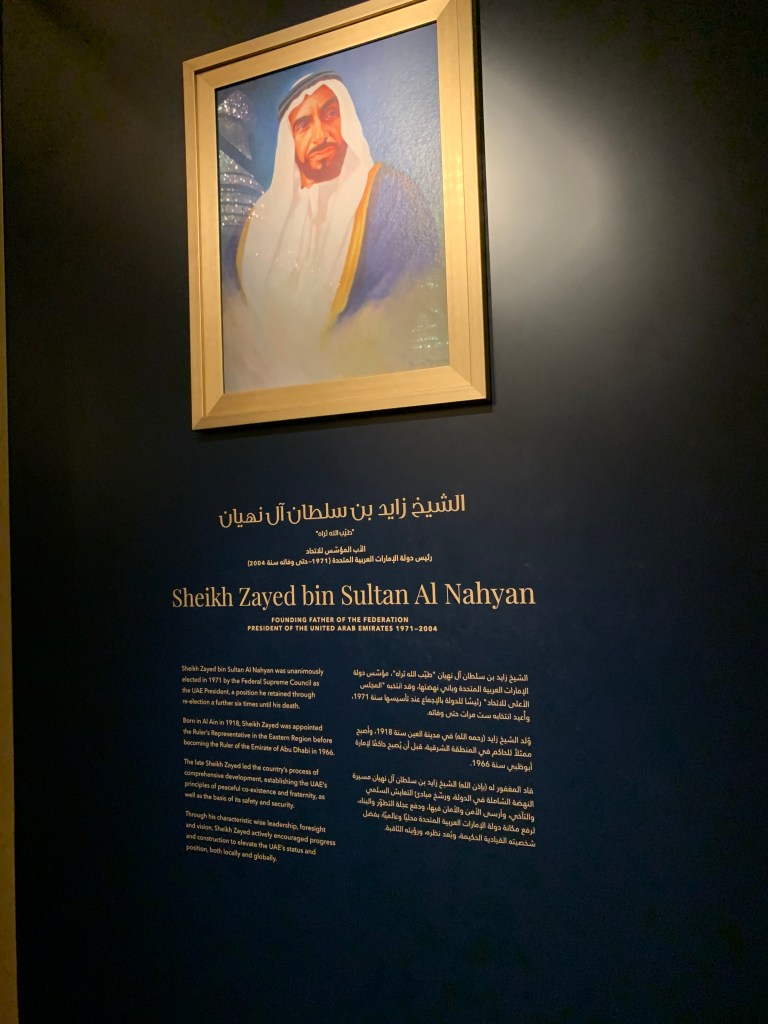
Sheikh Zayed ruled from 1971 until his death in 2004. Emiratis affectionately refer to Abu Dhabi as Bu Dhabi since their founding father has passed. We still see everywhere large, framed pictures of him, always next to a picture of his son Khalifa bin Zayed al Nahyan, the current UAE president.
The ongoing respect is not only because he was the first president of the UAE, explains our guide, but because his ‘benevolent dictatorship’ (my words) guided their swift climb out of poverty while embracing their tribal past. His wish to be an oasis for peace and hope in the Middle East lives on through his son. We witness his legacy at the newly opened Abrahamic Family House, an interfaith complex in Abu Dhabi’s cultural district. The full sized mosque, church, and synagogue represent the peaceful coexistence of Islam, Christianity, and Judaism.
As our plane ascends homeward above rain-seeded clouds, I can’t help think we were in an alternate reality. How can such a small nation be so global-minded and futuristic while preserving its tribal ancestry and religious beliefs? Back home, yearend local news highlight the tearing down of homeless camps and top CEOs earning more in a week than we could make in a year. Our democratic values are a jarring contradiction to the values and visionary leadership that make this Muslim country so fascinating – and just maybe, a model for world peace and tolerance. I can’t wait to return.

 word traveller
This was an excellent article! Very well written and I learned lots too, so thank you!
LikeLike
I really enjoyed reading this- it would be wonderful to go there some day! Curious- if the people are given their education, healthcare and housing, do they still work in order to earn money to pay for food and clothing, etc.? And how are things kept equitable for citizens? Looking forward to learning more!
LikeLike
Off the top of my head I would say saving for retirement (theirs and their parents), perhaps home care for poorer parents, travel (on Air Emirates), expensive imported cars (state gas is cheap) and designer clothes and accessories. They are expected to donate to charity each year. At the airport lounge I sat beside an attractive 40something Muslim woman in black hijab and abaya (long robe) and could see the designer boots, purse, and gold rings and bracelets. It was not uncommon to see women conservatively covered with fashionable shoes and purses and jewelry peeking out. Women do not have to dress so modestly in the UAE, but may choose to.
LikeLike
What a good article. It sounds like a fabulous trip.
Sharene
LikeLike
It really was, all the more because we had a local guide and learned so much more than if we came as solo tourists.
LikeLike